ChargeWipe
ChargeWipe

What is Chargeback?

A chargeback refers to a refund request submitted by a cardholder to the issuing bank when they dispute a transaction. The issuing bank will review the request and, if necessary, reverse the funds from the merchant's account back to the cardholder's account. Common reasons include non-delivery of goods, product discrepancies from the description, unauthorized fraudulent transactions, duplicate charges, and more. It is one of the core payment risks faced by cross-border e-commerce, which not only causes direct revenue losses but may also negatively impact a merchant's payment channel rating.

What is Chargeback?

Types of Chargeback

Specific Scenarios

Non-delivery of goods

The most frequent type of chargeback. After payment is completed, the cardholder fails to receive physical goods within the agreed time limit; with no updates to the logistics tracking, lost packages, or valid delivery confirmation records. It also includes undelivered virtual products, inactive membership benefits, and unsuccessful recharge services.

Product not as described

The received physical goods have quality issues such as damage or defects, or the style, material and specifications are significantly inconsistent with the merchant’s promotion.

Transaction errors

Chargebacks initiated for abnormal orders in the payment process, including duplicate charges for a single order, discrepancies between billed amounts and actual payment amounts, and transaction misunderstandings caused by abnormal merchant name displays that confuse cardholders.

Inadequate service & refund failures

After the cardholder applies for returns or order cancellation normally, the merchant delays refunds unreasonably, or rejects legitimate refund requests without proper reasons, leaving the cardholder unable to recover funds via after-sales channels.

Fraudulent transactions

The cardholder’s bank card is stolen or used fraudulently; the consumption was not authorized or operated by the cardholder themselves.

Friendly fraud

Cardholders maliciously file false complaints using excuses such as "goods not matching description" in an attempt to obtain products for free.

Losses & Impacts

Losses & Impacts

1.Direct Financial Losses

  • Loss of transaction principal

    Merchants must fully refund the funds related to disputed orders. Such amounts constitute direct revenue losses and are generally irrecoverable through other channels.

  • Chargeback penalties & fees

    For every valid chargeback, card schemes (e.g., Visa, Mastercard) and acquiring banks will impose fixed or proportional chargeback fines and handling fees in accordance with agreements and industry rules. All such fees are borne solely by the merchant.

  • Loss of goods & logistics costs

    If goods have already been shipped, merchants still bear production, procurement, shipping, warehousing and fulfillment expenses, which cannot be offset by transaction revenue.

  • Dispute appeal costs

    Contesting chargebacks requires labor for evidence collection, document verification, and compliance submission. Manpower and administrative expenses incurred are additional overheads.

2.Comprehensive Operational Impacts

Restrictions on Payment Channels & Settlement Rights

Fund settlement controls

Payment providers may impose fund limits, freeze accounts, extend withdrawal cycles, or suspend settlements entirely. In severe cases, large security deposits may be required, and settlement funds may be withheld, severely threatening cash flow stability.

Credit rating downgrade

Card schemes and payment platforms flag high‑risk merchants and lower their credibility ratings, directly affecting future payment channel access and partnership eligibility.

Risk of channel termination

If the merchant’s chargeback rate continuously exceeds industry thresholds (typically capped at 1% by major card schemes), payment providers reserve the right to unilaterally close payment channels and disable receiving capabilities.

Damage to Store Operations & Brand Reputation

Declining platform weight

E‑commerce systems (Amazon, Shopify, independent stores, etc.) include chargeback rates in store scoring. Higher chargebacks reduce store authority, lower search rankings, cut traffic recommendations, and harm conversion rates and sales volume.

Collapsed store reputation

Many platforms disclose chargeback metrics or reduce exposure and recommendations. Negative feedback spreads through reviews and social channels, weakening customer trust and lowering conversion and repeat purchase rates.

Long‑term brand damage

Frequent chargeback disputes damage industry credibility, weaken cooperation trust with suppliers and distribution partners, and restrict long‑term brand expansion and business layout.

Long‑term Growth & Industry Access Risks

Higher entry barriers

Merchants listed on card scheme high‑risk blacklists face stricter reviews when applying for new payment channels or joining mainstream platforms. They are subject to higher processing fees and harsher contract terms.

Limited business expansion

Both cross‑border overseas expansion and domestic channel development are hindered by historical chargeback records, blocking new business growth and restricting overall long‑term development potential.

Chargeback Alerts

  • Chargeback Alert is a proactive risk intervention mechanism launched jointly by card schemes, issuing banks and third-party risk control platforms for card-not-present credit card transaction disputes. Before a cardholder officially files a chargeback and funds are reversed, the system sends transaction dispute notifications to merchants with an exclusive processing window. This allows merchants to resolve disputes actively and block the generation of formal chargebacks, making it a core risk control tool for cross-border payments and online acquiring scenarios.

  • There are three mainstream authoritative alert channels : Verifi RDR is an exclusive channel for Visa, supporting automated processing and closed-loop dispute resolution to greatly reduce manual work;Verifi CDRN covers multiple card schemes, provides sufficient time for independent handling, and supports refined negotiation and fallback solutions;Ethoca, built on the Mastercard ecosystem, features ultra-real-time alerts to accurately capture fraud signals and early dispute warnings.

  • ChargeWipe has completed deep integration with the three mainstream alert channels — RDR, CDRN and Ethoca — enabling real-time synchronization of all risk signals. We identify potential risks across all scenarios, lower chargeback rates at the source, and stabilize merchants’ receiving channels and payment ratings.

Chargeback Alerts

Automated Alerts

Verifi RDR

Verifi RDR

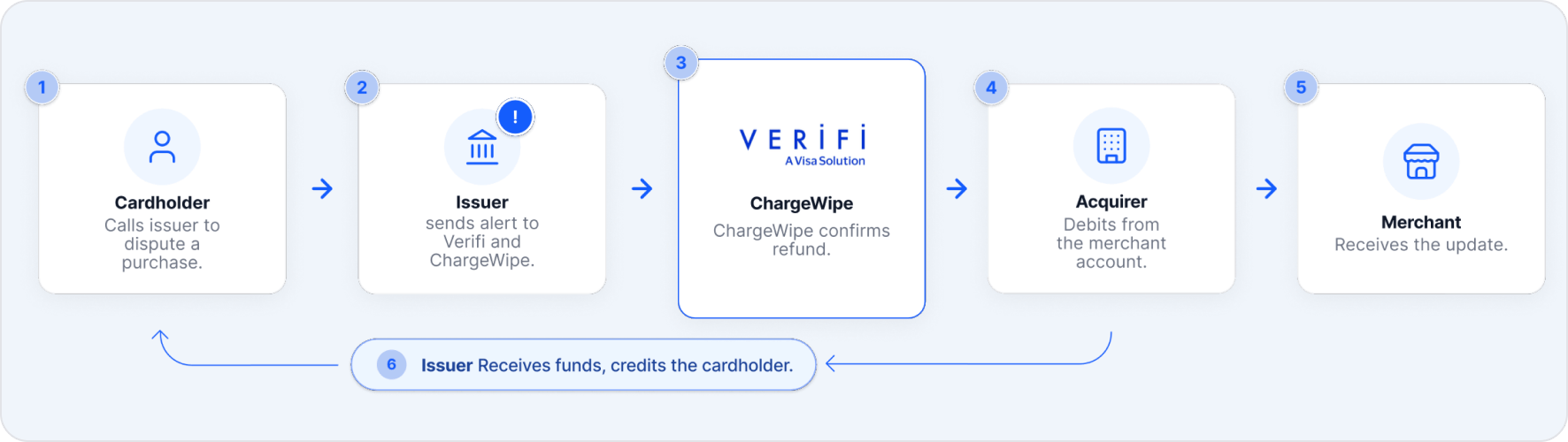
An automated dispute solution provided by Verifi under Visa. It applies only to Visa transactions. The system can resolve disputes and process refunds automatically, closing cases before formal chargebacks occur without impacting the account’s fraud rate. It delivers fully automated chargeback alerts with higher efficiency, ideal for merchants with high transaction volumes and fast response requirements.

Self-Decisioned Alerts

Verifi CDRN

Verifi CDRN

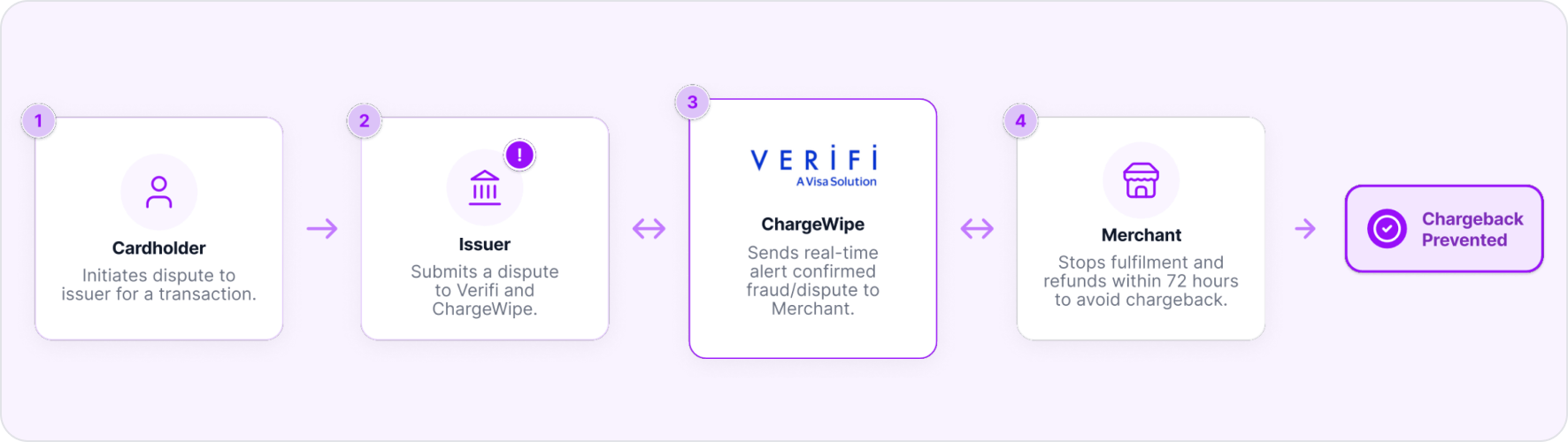
A cross-scheme dispute alert and collaboration network from Verifi under Visa. Covering Visa, Mastercard and other card brands, it sends early notifications once a cardholder raises a dispute, generally offering a 72-hour processing window. Merchants may issue manual refunds or provide clarifications to prevent disputes from escalating into chargebacks. Suitable for merchants needing multi-card coverage and full manual control over dispute handling.

Ethoca Alerts

Ethoca Alerts

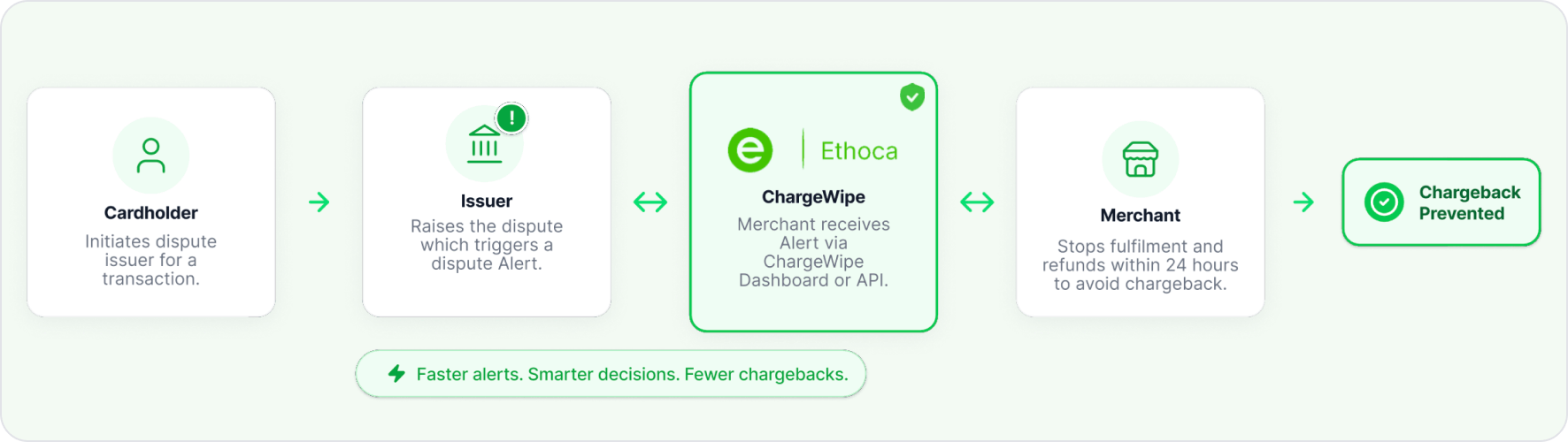
A globally recognized dispute alert platform under Mastercard. Powered by verified fraud and dispute data from issuing banks, it delivers real-time alerts with a response window within 24 hours; timely action can prevent chargebacks entirely. It mainly covers Mastercard while also supporting Visa, Amex and other card brands, perfect for merchants requiring full-network card coverage and early fraud signal detection.

ChargeWipe

The ChargeWipe Chargeback Alert Management Platform is a unified merchant-side alert processing system built on official card scheme alert channels. It enables fully online management throughout the entire process — from alert reception and order verification to action handling and result closure — providing merchants with standardized, automated proactive intervention against chargebacks.

1.Core Features

  • Unified Alert Integration

    One-stop access to three official alert channels from two major card schemes, supporting real-time push and centralized display of all chargeback alert information.

  • Visual Risk Dashboard

    Prevents information omission and delays, ensuring merchants perceive risks at the earliest opportunity.

  • Standardized Disposal Actions

    Supports compliant operations such as full refund, negotiated case closure, and pending processing; results are synchronized to card scheme alert systems in real time to shorten the response window.

  • Full-Link Recording, Archiving & Analysis

    Completely retains all records of alert reception, verification, disposal and feedback, assisting merchants with business reviews and financial reconciliation, and enabling continuous optimization of risk control strategies.

  • Compliance Guarantee

    Fully aligns with alert rules of card schemes including Visa and Mastercard. The entire disposal process is traceable with complete records, meeting regulatory and card scheme audit requirements.

2.Application Scenarios

  • High-Risk Category Prevention

    For chargeback-prone categories such as daily necessities, apparel, consumer electronics, and virtual goods, intercept fraud alerts in advance to avoid losses from individual orders.

  • Peak Season Protection

    Efficiently process massive alerts during transaction peaks such as Black Friday and Christmas, strictly comply with response time limits, and fully stabilize store risk control performance.

  • Compliance Onboarding for New Merchants

    Help newly onboard cross-border merchants quickly build chargeback risk control capabilities, meet chargeback rate compliance requirements from payment channels, and prevent account restrictions.

  • Optimization for Established Merchants

    Provide mature merchants with data insights to identify high-risk links, optimize product strategies and payment workflows, and continuously reduce overall chargeback rates.